
Aging Baby Pigeons
24 hours old
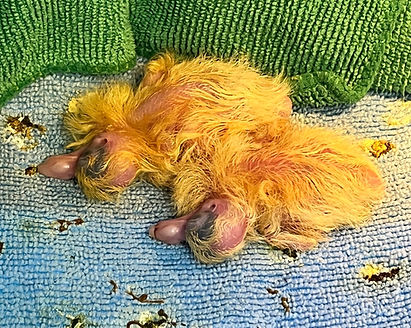
A baby pigeon is called a Squab. They will be very small, once dry from hatching they are covered in yellow fluff & have their eyes closed.
Once hatched a squab will not require feeding for a few hours (anything up to 12 hours after hatching) as they will be exhausted from their struggle to hatch and as such will be resting.


48 - 72 hours old
Once the baby is past a day old it will start to be able to sit more upright.
They will make a high-pitched squeak & move with a bounce, although they will not be able to get out of the nest, they can shuffle around it & will move to the edge when they need to empty their bowels or get warm or cooler.
When sleeping they can often look dead which worries most people due to the way they just crash out with their heads at a weird angle. Usually watching them for a few seconds will prove they are ok as they often fidget or jerk, even when sleeping.


3 - 6 days old
3 days old & they will have nearly doubled in size & weight from when they first hatched.
Whilst you may notice their eyes slightly cracked open, they can not see very well, if at all at this age.
See here for a video of squabs at 3 days old


7 - 8 days old
By 7 days old, their weight should now be around 55 grams. You may even notice slight colouring on the body if the bird is not pure white.
Tiny pin feathers should start to become visible on the bird's wings. If the bird has any colouring, it's beak may start to change colour.
Click here for a video of a week-old pigeon being fed by its parent.


9 - 11 days old
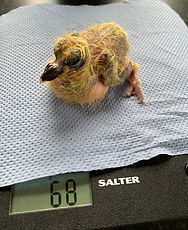
At 9 days old the baby will have their eyes open most of the time. At 10 days old they are now becoming far more mobile & 4 times bigger than they were at hatching, coming in at around 80 grams in weight


12 - 15 days old
At 12 days old, the pin feathers should be coming in well & the bird should be around 120 grams.
They will be far more alert & vocal.
Colouring should be far more obvious & the bird is now starting to be able to maintain its own body heat but is still vulnerable to heat or cold.
The bird will now be able to start pushing themselves up onto their legs, but will still be very unsteady. They will flap their wings excitedly when feeding.


16 - 18 days old
At 16 - 18 days old, they will be clumsy but able to stand better, resting on their legs rather than up onto their feet. They will actively start asking for food by nibbling at your hands & trying to push their beaks in between your fingers etc.


9 - 23 days old
The bird will now be quite mobile so care must be taken for them not to fall off ledges or worktops etc. They are at the age where everything is interesting & want to explore, so this is a high-risk time if they are used to being fed as they will now start trying to get to you to greet you with no regard for their own safety.
They will be very noisy at this age, emitting a high-pitched squeak most of their waking time. Whilst they are still technically squabs, many pigeon keepers will use the term Squeaker to describe this period in their adolescence since they are constantly squeaking & flapping/shrugging.
Click here for a video of 23-day-old pigeons

23 - 28 days old
Click here for a video of 21-day-old pigeons
Click here for a video of 25-day-old pigeons
Click here for a video of pigeons ranging from 3 - 4 weeks old
At around 26 - 28 days old the squeaker will now be showing an interest in feeding themselves, as well as flapping to stretch their wings and exercise.
They will start investigating things and learning to pick up seeds but will most likely not master this skill for a few days. By now they should be showing far more interest in exploring the area around their nest & starting to flutter or even hover on the spot, flapping.


30 days old
At 30 days old the squeaker will be looking more like a small pigeon and starting to fill out. If they are in a nest, they will start to poke their head out of the area to take in their surroundings. Their feathers should now be nearly all through. Usually, the underside of the wings is the last area to grow in. Some birds will now develop a honking noise as they start to hit puberty. They will also start to squeak less & become quieter.


30 - 40 days old
Click here for a video of 30-day-old pigeons
They will be almost unrecognisable as a squeaker. This is the age when they will be attempting to fly & leave the nest. Most squeakers leave their nests between 4-6 weeks of age, sometimes earlier depending on if the parents are ready to raise more young in the same nest, then they will actively encourage the squeaker to fledge the nest.
If you have hand reared the bird & it's imprinted, this is also the age they may start to show aggression as they hit puberty. They will be far less inclined to be handled & most likely move away from your hands if you try to pick them up.

60 days old
At 60 days old the squeaker should now have mostly stopped squeaking, except when excited or startled. They will look very much like an adult pigeon, but perhaps a little out of proportion as they are still filling out. Depsingin on the breed of pigeon, they may start showing an interest in the opposite sex & showing behaviours which will make it easier to work out the sex of the bird.
Some breeds won't mature as fast as others, so some (such as racing breeds) tend to not show this behaviour until 4-6 months old.
The wattle (fleshy area) at the top of the beak (also known as cere) will now also start to change colour. Instead of being a pinky colour, it will either start to turn white or light grey depending on the birds colouring.
This is also the age when the bird will start going through their first moult. They will have a small window of time between being fully feathered as a youngster & then going through a moult which will make them look a mess whilst all their feathers are replaced. This can take several weeks & the bird will look dishevelled for a few weeks but this is totally normal and can vary at slightly different points in the bird's early life depending on the breed but is usually within the first 3 - 6 months of their life.
Click here for a video of a young bird going through their first moult.
